🚚 Free Worldwide Shipping on All Orders!Shop Now

1 / 2
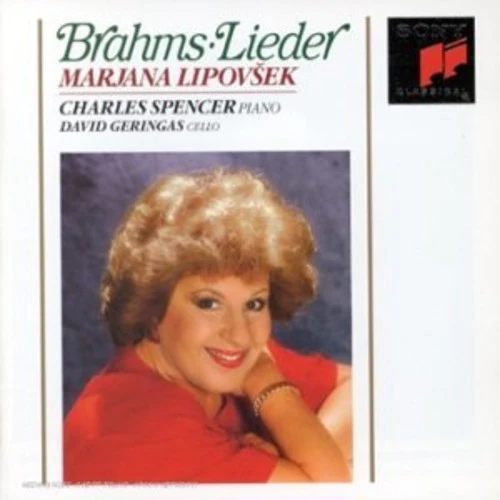
Brahms: Lieder / Marjana Lipovsek, Charles Spencer
After Robert Holl’s outstanding recent disc of Brahms Lieder, Marjana Lipovsek, a singer of no less searching musical sense and sensibility, adds her own selection to the catalogue. Her strong and spirited Eastern European mezzo-soprano brings an appropriate inwardness and intensity to four of the five Op. 105 songs. Purposeful phrasing runs gently through the senses in ‘Wie Melodien zieht es’, like the song’s eponymous melody, and penetrates the very heart of the soul’s winter in ‘Immer leiser’. All, though, is not angst. Lipovsek and her accompanist Charles Spencer are sensitive to the rapidly shifting moods within a group of songs, so that the numb darkness of Heine’s cool night of death is recreated as evocatively as the light-filled morning of his ‘Es schauen die Blumen’. Later, a steely vocal strength for ‘Von ewiger Liebe’ can dissolve to the lunar evanescence of ‘Die Mainacht’. Lipovsek’s thrilling grasp of the regional idiom of the final three folksongs is in glaring contrast to the infelicitous English (American) translations in the accompanying text: I doubt that Brahms’s poets would own up to an ‘incalibrate glow’, a ‘cute little child’ or, still worse, ‘a together time’.
-- Hilary Finch, BBC Music Magazine
-- Hilary Finch, BBC Music Magazine
$13.99
Brahms: Lieder / Marjana Lipovsek, Charles Spencer—
$13.99
Product Information
Product Information
Shipping & Returns
Shipping & Returns
Description
After Robert Holl’s outstanding recent disc of Brahms Lieder, Marjana Lipovsek, a singer of no less searching musical sense and sensibility, adds her own selection to the catalogue. Her strong and spirited Eastern European mezzo-soprano brings an appropriate inwardness and intensity to four of the five Op. 105 songs. Purposeful phrasing runs gently through the senses in ‘Wie Melodien zieht es’, like the song’s eponymous melody, and penetrates the very heart of the soul’s winter in ‘Immer leiser’. All, though, is not angst. Lipovsek and her accompanist Charles Spencer are sensitive to the rapidly shifting moods within a group of songs, so that the numb darkness of Heine’s cool night of death is recreated as evocatively as the light-filled morning of his ‘Es schauen die Blumen’. Later, a steely vocal strength for ‘Von ewiger Liebe’ can dissolve to the lunar evanescence of ‘Die Mainacht’. Lipovsek’s thrilling grasp of the regional idiom of the final three folksongs is in glaring contrast to the infelicitous English (American) translations in the accompanying text: I doubt that Brahms’s poets would own up to an ‘incalibrate glow’, a ‘cute little child’ or, still worse, ‘a together time’.
-- Hilary Finch, BBC Music Magazine
-- Hilary Finch, BBC Music Magazine