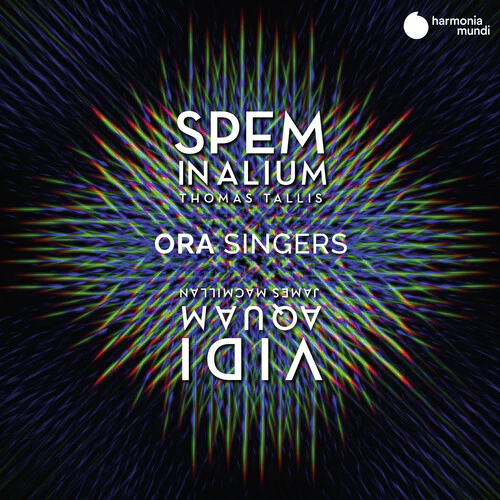
Tallis: Spem in Alium - MacMillan: Vidi Aquam / Digby, Ora Singers
A musical banquet from the Golden Age. This programme brings together a true choral landmark from the sixteenth century, with its present-day reflection, a commission by Sir James MacMillan. These two monumental, large-scale pieces bookend a ‘tasting menu’ of Renaissance works by Byrd, Tallis and many other composers. Common to them all is a link to Nonsuch Palace, arguably the location of the first performance of Spem in alium, and the centre of a rich vein of Tudor musical patronage.
-----
REVIEW:
Standing at either end of this programme are the forty-part motets. Spem in alium is very familiar and is widely acknowledged as a masterpiece of Tudor polyphony. Suzi Digby directs a performance that is simply magnificent. She had at her disposal a group of expert singers who were positioned in a circle with the conductor at the apex. The combined skills of the musician and the engineers means that, even in “vanilla” stereo the listener gets a very clear sense of the eight separate choirs – goodness knows what the performance would sound like in surround sound! There’s a truly thrilling sound at the points where the full ensemble sings flat-out, but just as impressive are the more subdued passages, which are delivered with admirable subtlety.
It can’t be an easy task to compose a homage to Spem but few composers are better equipped than Sir James MacMillan who has shown a deep understanding of and respect for the music of the Renaissance – notably that of Robert Carver – in some of his previous scores. In the booklet he comments that he “used the Tallis original as an inspiration in the way I utilised the eight five-voiced choirs, and how I moved the music from choir to choir, gradually building the sound up from one to forty voices.” He doesn’t quote from Spem in his score but he has used the structure of Tallis’s masterpiece as an inspiration. For his text, MacMillan used the text ‘Vidi aquam’ from the prophecy of Ezekiel.
As a homage to the great Tudor masterpiece, I’d say that Vidi aquam is an unqualified success. More than that, though, I’d say the work is a masterpiece in its own right. It is a wonderful response to the chosen text. In addition, it challenges both performers and listeners, yet it never leaves the listener behind because it exercises a huge sensory appeal.
The camera work and sound on the DVD is excellent. As for the CD, producer Nick Parker and engineer Mike Hatch have made a fantastic job of the recording. All the smaller pieces benefit from clarity and intimacy of sound. The two big pieces have been captured with great success. You can hear an abundance of detail and when the full ensemble sings out at full volume, the sound is magnificent. John Milsom’s notes are first-rate.
This is a simply terrific disc. I’ve admired all of the previous ORA Singers releases but, considering both the expert performances of the smaller works and the thrilling forty-part performances, I’m inclined to think this is their finest achievement to date.
– MusicWeb International (John Quinn)
Original: $37.72
-70%$37.72
$11.32Product Information
Product Information
Shipping & Returns
Shipping & Returns
Description
A musical banquet from the Golden Age. This programme brings together a true choral landmark from the sixteenth century, with its present-day reflection, a commission by Sir James MacMillan. These two monumental, large-scale pieces bookend a ‘tasting menu’ of Renaissance works by Byrd, Tallis and many other composers. Common to them all is a link to Nonsuch Palace, arguably the location of the first performance of Spem in alium, and the centre of a rich vein of Tudor musical patronage.
-----
REVIEW:
Standing at either end of this programme are the forty-part motets. Spem in alium is very familiar and is widely acknowledged as a masterpiece of Tudor polyphony. Suzi Digby directs a performance that is simply magnificent. She had at her disposal a group of expert singers who were positioned in a circle with the conductor at the apex. The combined skills of the musician and the engineers means that, even in “vanilla” stereo the listener gets a very clear sense of the eight separate choirs – goodness knows what the performance would sound like in surround sound! There’s a truly thrilling sound at the points where the full ensemble sings flat-out, but just as impressive are the more subdued passages, which are delivered with admirable subtlety.
It can’t be an easy task to compose a homage to Spem but few composers are better equipped than Sir James MacMillan who has shown a deep understanding of and respect for the music of the Renaissance – notably that of Robert Carver – in some of his previous scores. In the booklet he comments that he “used the Tallis original as an inspiration in the way I utilised the eight five-voiced choirs, and how I moved the music from choir to choir, gradually building the sound up from one to forty voices.” He doesn’t quote from Spem in his score but he has used the structure of Tallis’s masterpiece as an inspiration. For his text, MacMillan used the text ‘Vidi aquam’ from the prophecy of Ezekiel.
As a homage to the great Tudor masterpiece, I’d say that Vidi aquam is an unqualified success. More than that, though, I’d say the work is a masterpiece in its own right. It is a wonderful response to the chosen text. In addition, it challenges both performers and listeners, yet it never leaves the listener behind because it exercises a huge sensory appeal.
The camera work and sound on the DVD is excellent. As for the CD, producer Nick Parker and engineer Mike Hatch have made a fantastic job of the recording. All the smaller pieces benefit from clarity and intimacy of sound. The two big pieces have been captured with great success. You can hear an abundance of detail and when the full ensemble sings out at full volume, the sound is magnificent. John Milsom’s notes are first-rate.
This is a simply terrific disc. I’ve admired all of the previous ORA Singers releases but, considering both the expert performances of the smaller works and the thrilling forty-part performances, I’m inclined to think this is their finest achievement to date.
– MusicWeb International (John Quinn)