🚚 Free Worldwide Shipping on All Orders!Shop Now

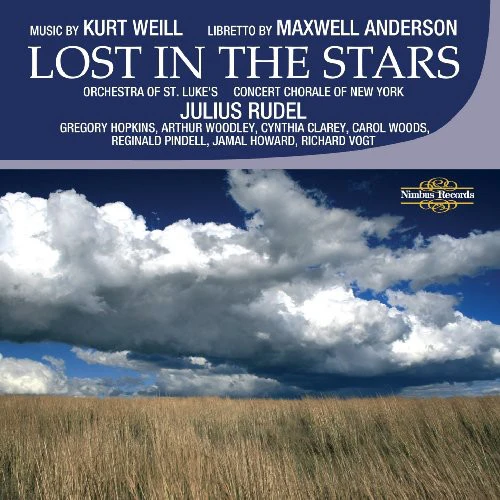
Weill: Lost In The Stars / Rudel, Concert Chorale Of New York
Weill’s last completed work given a fine, dramatic reading.
Lost in the Stars is Weill’s last completed work. It was based on the novel, Cry the Beloved Country by the South African writer, Alan Paton (1903-1988) and represents a very speedy adaptation, since Paton’s book was only published in 1948. Yet by the following year Weill and his librettist, Maxwell Anderson (1888-1959), had written the musical, which opened on Broadway in October 1949, where the original production ran for 273 performances.
In brief, the story concerns Stephen Kumalo, an African pastor, serving in a South African country parish, whose son, Absalom, has gone off to find work and a better life in Johannesburg. There he meets Irina, who conceives their child, but he also falls in with some less suitable male company and with these men he takes part in a burglary, during the course of which a white man – ironically, a campaigner for racial equality in Paton’s novel - is killed. When Stephen, unaware of these events, arrives in Johannesburg to search for his son he eventually finds the pregnant Irina and then locates his son, who is in jail, awaiting trial.
Inevitably Absalom is found guilty and sentenced to death. Not only are father and son reconciled but Stephen realises Irina’s worth. He marries the couple in jail so that their child will have Absalom’s name, and then takes Irina back to the family home and his parish where she is taken into the family’s care before the death sentence on Absalom is carried out.
This is emphatically not a conventional subject for a Broadway musical – like the earlier groundbreaking Showboat, which addressed the issue of miscegenation, it tackles a tough subject but it’s much more gritty than Jerome Kern’s great show. As David Kilroy observes in his excellent note, Lost in the Stars created in 1949 “a musico-dramatic parable of a new social order for an American public floundering with its own racial prejudices in the immediate postwar era.” In fact, in many ways it takes us back to the world of Weill’s collaborations with Bertolt Brecht. For example, there are some similarities in the musical styles. The scoring is for a small ensemble of some sixteen players and quite often the instrumental writing is pungent in a way that recalls those Brecht shows.
Lost in the Stars was Weill’s last completed work and it’s a fine creation, its quality emphasised by this excellent performance. We only get the musical numbers together with some of the spoken dialogue but the story line is not compromised.
The musical invention is strong; there are several memorable numbers in the show. The best of them fall to the character of Stephen and, in a strong cast, Arthur Woodley is one of the best performers of all. He has a fine, firm voice. His tone is consistently strong and round and his diction is excellent – though the libretto is printed it’s almost superfluous since all the cast enunciate very clearly. Woodley brings dignity and intensity to the role and among the highlights of the entire performance are his renditions of ‘Little Gray House’ and the title song. He also gives an excellent account of the emotionally charged soliloquy, ‘O Tixo, Tixo, Help Me!’ in Act II.
The other principal character is Irina, Absalom’s girlfriend. Cynthia Clarey gives a strong account of Irina’s music, singing ‘Stay Well’ expressively and delivering the touching ‘Trouble Man’ with real feeling. My one reservation is that her voice is a big, mature instrument and it might be thought rather too heavy to suggest a young, frightened and vulnerable girl.
Also impressive is Gregory Hopkins as the Leader of the chorus. He has a ringing, pliant tenor voice, which serves the opening number ‘The Hills of Ixopo’ very well. Even better is the ardent song, ‘Cry the Beloved Country’. Incidentally, great trouble has evidently been taken to ensure authentic pronunciation by all the cast; an adviser from the South African embassy, Tuli Demikude, was retained specially for this purpose
The chorus and orchestra are very fine indeed, bringing out all the tension and bite in Weill’s score but providing the right emotional charge. Julius Rudel directs proceedings with evident commitment to the score. The rhythms are kept tight and the memorable tunes flow most convincingly.
The recorded sound is perhaps a little close but not in any troubling way. Indeed, there’s rather a feel of the performance being mounted in a small theatre. Perhaps, though, that feeling is more down to the dramatic flair of this performance. The work clearly matters a great deal to Rudel, who says in a brief introductory comment that he regards it as “a composition of great depth, deceptively couched in simple settings.” That belief in the score shines through in his fine, dramatic reading.
Originally made for the MusicMasters catalogue, it’s excellent news that the recording has now been reissued by Nimbus. All admirers of Kurt Weill will want to add it to their collections but it should be heard by anyone interested in the unique art-form that is the American Musical.
-- John Quinn, MusicWeb International
Lost in the Stars is Weill’s last completed work. It was based on the novel, Cry the Beloved Country by the South African writer, Alan Paton (1903-1988) and represents a very speedy adaptation, since Paton’s book was only published in 1948. Yet by the following year Weill and his librettist, Maxwell Anderson (1888-1959), had written the musical, which opened on Broadway in October 1949, where the original production ran for 273 performances.
In brief, the story concerns Stephen Kumalo, an African pastor, serving in a South African country parish, whose son, Absalom, has gone off to find work and a better life in Johannesburg. There he meets Irina, who conceives their child, but he also falls in with some less suitable male company and with these men he takes part in a burglary, during the course of which a white man – ironically, a campaigner for racial equality in Paton’s novel - is killed. When Stephen, unaware of these events, arrives in Johannesburg to search for his son he eventually finds the pregnant Irina and then locates his son, who is in jail, awaiting trial.
Inevitably Absalom is found guilty and sentenced to death. Not only are father and son reconciled but Stephen realises Irina’s worth. He marries the couple in jail so that their child will have Absalom’s name, and then takes Irina back to the family home and his parish where she is taken into the family’s care before the death sentence on Absalom is carried out.
This is emphatically not a conventional subject for a Broadway musical – like the earlier groundbreaking Showboat, which addressed the issue of miscegenation, it tackles a tough subject but it’s much more gritty than Jerome Kern’s great show. As David Kilroy observes in his excellent note, Lost in the Stars created in 1949 “a musico-dramatic parable of a new social order for an American public floundering with its own racial prejudices in the immediate postwar era.” In fact, in many ways it takes us back to the world of Weill’s collaborations with Bertolt Brecht. For example, there are some similarities in the musical styles. The scoring is for a small ensemble of some sixteen players and quite often the instrumental writing is pungent in a way that recalls those Brecht shows.
Lost in the Stars was Weill’s last completed work and it’s a fine creation, its quality emphasised by this excellent performance. We only get the musical numbers together with some of the spoken dialogue but the story line is not compromised.
The musical invention is strong; there are several memorable numbers in the show. The best of them fall to the character of Stephen and, in a strong cast, Arthur Woodley is one of the best performers of all. He has a fine, firm voice. His tone is consistently strong and round and his diction is excellent – though the libretto is printed it’s almost superfluous since all the cast enunciate very clearly. Woodley brings dignity and intensity to the role and among the highlights of the entire performance are his renditions of ‘Little Gray House’ and the title song. He also gives an excellent account of the emotionally charged soliloquy, ‘O Tixo, Tixo, Help Me!’ in Act II.
The other principal character is Irina, Absalom’s girlfriend. Cynthia Clarey gives a strong account of Irina’s music, singing ‘Stay Well’ expressively and delivering the touching ‘Trouble Man’ with real feeling. My one reservation is that her voice is a big, mature instrument and it might be thought rather too heavy to suggest a young, frightened and vulnerable girl.
Also impressive is Gregory Hopkins as the Leader of the chorus. He has a ringing, pliant tenor voice, which serves the opening number ‘The Hills of Ixopo’ very well. Even better is the ardent song, ‘Cry the Beloved Country’. Incidentally, great trouble has evidently been taken to ensure authentic pronunciation by all the cast; an adviser from the South African embassy, Tuli Demikude, was retained specially for this purpose
The chorus and orchestra are very fine indeed, bringing out all the tension and bite in Weill’s score but providing the right emotional charge. Julius Rudel directs proceedings with evident commitment to the score. The rhythms are kept tight and the memorable tunes flow most convincingly.
The recorded sound is perhaps a little close but not in any troubling way. Indeed, there’s rather a feel of the performance being mounted in a small theatre. Perhaps, though, that feeling is more down to the dramatic flair of this performance. The work clearly matters a great deal to Rudel, who says in a brief introductory comment that he regards it as “a composition of great depth, deceptively couched in simple settings.” That belief in the score shines through in his fine, dramatic reading.
Originally made for the MusicMasters catalogue, it’s excellent news that the recording has now been reissued by Nimbus. All admirers of Kurt Weill will want to add it to their collections but it should be heard by anyone interested in the unique art-form that is the American Musical.
-- John Quinn, MusicWeb International
$16.99
Weill: Lost In The Stars / Rudel, Concert Chorale Of New York—
$16.99
Product Information
Product Information
Shipping & Returns
Shipping & Returns
Description
Weill’s last completed work given a fine, dramatic reading.
Lost in the Stars is Weill’s last completed work. It was based on the novel, Cry the Beloved Country by the South African writer, Alan Paton (1903-1988) and represents a very speedy adaptation, since Paton’s book was only published in 1948. Yet by the following year Weill and his librettist, Maxwell Anderson (1888-1959), had written the musical, which opened on Broadway in October 1949, where the original production ran for 273 performances.
In brief, the story concerns Stephen Kumalo, an African pastor, serving in a South African country parish, whose son, Absalom, has gone off to find work and a better life in Johannesburg. There he meets Irina, who conceives their child, but he also falls in with some less suitable male company and with these men he takes part in a burglary, during the course of which a white man – ironically, a campaigner for racial equality in Paton’s novel - is killed. When Stephen, unaware of these events, arrives in Johannesburg to search for his son he eventually finds the pregnant Irina and then locates his son, who is in jail, awaiting trial.
Inevitably Absalom is found guilty and sentenced to death. Not only are father and son reconciled but Stephen realises Irina’s worth. He marries the couple in jail so that their child will have Absalom’s name, and then takes Irina back to the family home and his parish where she is taken into the family’s care before the death sentence on Absalom is carried out.
This is emphatically not a conventional subject for a Broadway musical – like the earlier groundbreaking Showboat, which addressed the issue of miscegenation, it tackles a tough subject but it’s much more gritty than Jerome Kern’s great show. As David Kilroy observes in his excellent note, Lost in the Stars created in 1949 “a musico-dramatic parable of a new social order for an American public floundering with its own racial prejudices in the immediate postwar era.” In fact, in many ways it takes us back to the world of Weill’s collaborations with Bertolt Brecht. For example, there are some similarities in the musical styles. The scoring is for a small ensemble of some sixteen players and quite often the instrumental writing is pungent in a way that recalls those Brecht shows.
Lost in the Stars was Weill’s last completed work and it’s a fine creation, its quality emphasised by this excellent performance. We only get the musical numbers together with some of the spoken dialogue but the story line is not compromised.
The musical invention is strong; there are several memorable numbers in the show. The best of them fall to the character of Stephen and, in a strong cast, Arthur Woodley is one of the best performers of all. He has a fine, firm voice. His tone is consistently strong and round and his diction is excellent – though the libretto is printed it’s almost superfluous since all the cast enunciate very clearly. Woodley brings dignity and intensity to the role and among the highlights of the entire performance are his renditions of ‘Little Gray House’ and the title song. He also gives an excellent account of the emotionally charged soliloquy, ‘O Tixo, Tixo, Help Me!’ in Act II.
The other principal character is Irina, Absalom’s girlfriend. Cynthia Clarey gives a strong account of Irina’s music, singing ‘Stay Well’ expressively and delivering the touching ‘Trouble Man’ with real feeling. My one reservation is that her voice is a big, mature instrument and it might be thought rather too heavy to suggest a young, frightened and vulnerable girl.
Also impressive is Gregory Hopkins as the Leader of the chorus. He has a ringing, pliant tenor voice, which serves the opening number ‘The Hills of Ixopo’ very well. Even better is the ardent song, ‘Cry the Beloved Country’. Incidentally, great trouble has evidently been taken to ensure authentic pronunciation by all the cast; an adviser from the South African embassy, Tuli Demikude, was retained specially for this purpose
The chorus and orchestra are very fine indeed, bringing out all the tension and bite in Weill’s score but providing the right emotional charge. Julius Rudel directs proceedings with evident commitment to the score. The rhythms are kept tight and the memorable tunes flow most convincingly.
The recorded sound is perhaps a little close but not in any troubling way. Indeed, there’s rather a feel of the performance being mounted in a small theatre. Perhaps, though, that feeling is more down to the dramatic flair of this performance. The work clearly matters a great deal to Rudel, who says in a brief introductory comment that he regards it as “a composition of great depth, deceptively couched in simple settings.” That belief in the score shines through in his fine, dramatic reading.
Originally made for the MusicMasters catalogue, it’s excellent news that the recording has now been reissued by Nimbus. All admirers of Kurt Weill will want to add it to their collections but it should be heard by anyone interested in the unique art-form that is the American Musical.
-- John Quinn, MusicWeb International
Lost in the Stars is Weill’s last completed work. It was based on the novel, Cry the Beloved Country by the South African writer, Alan Paton (1903-1988) and represents a very speedy adaptation, since Paton’s book was only published in 1948. Yet by the following year Weill and his librettist, Maxwell Anderson (1888-1959), had written the musical, which opened on Broadway in October 1949, where the original production ran for 273 performances.
In brief, the story concerns Stephen Kumalo, an African pastor, serving in a South African country parish, whose son, Absalom, has gone off to find work and a better life in Johannesburg. There he meets Irina, who conceives their child, but he also falls in with some less suitable male company and with these men he takes part in a burglary, during the course of which a white man – ironically, a campaigner for racial equality in Paton’s novel - is killed. When Stephen, unaware of these events, arrives in Johannesburg to search for his son he eventually finds the pregnant Irina and then locates his son, who is in jail, awaiting trial.
Inevitably Absalom is found guilty and sentenced to death. Not only are father and son reconciled but Stephen realises Irina’s worth. He marries the couple in jail so that their child will have Absalom’s name, and then takes Irina back to the family home and his parish where she is taken into the family’s care before the death sentence on Absalom is carried out.
This is emphatically not a conventional subject for a Broadway musical – like the earlier groundbreaking Showboat, which addressed the issue of miscegenation, it tackles a tough subject but it’s much more gritty than Jerome Kern’s great show. As David Kilroy observes in his excellent note, Lost in the Stars created in 1949 “a musico-dramatic parable of a new social order for an American public floundering with its own racial prejudices in the immediate postwar era.” In fact, in many ways it takes us back to the world of Weill’s collaborations with Bertolt Brecht. For example, there are some similarities in the musical styles. The scoring is for a small ensemble of some sixteen players and quite often the instrumental writing is pungent in a way that recalls those Brecht shows.
Lost in the Stars was Weill’s last completed work and it’s a fine creation, its quality emphasised by this excellent performance. We only get the musical numbers together with some of the spoken dialogue but the story line is not compromised.
The musical invention is strong; there are several memorable numbers in the show. The best of them fall to the character of Stephen and, in a strong cast, Arthur Woodley is one of the best performers of all. He has a fine, firm voice. His tone is consistently strong and round and his diction is excellent – though the libretto is printed it’s almost superfluous since all the cast enunciate very clearly. Woodley brings dignity and intensity to the role and among the highlights of the entire performance are his renditions of ‘Little Gray House’ and the title song. He also gives an excellent account of the emotionally charged soliloquy, ‘O Tixo, Tixo, Help Me!’ in Act II.
The other principal character is Irina, Absalom’s girlfriend. Cynthia Clarey gives a strong account of Irina’s music, singing ‘Stay Well’ expressively and delivering the touching ‘Trouble Man’ with real feeling. My one reservation is that her voice is a big, mature instrument and it might be thought rather too heavy to suggest a young, frightened and vulnerable girl.
Also impressive is Gregory Hopkins as the Leader of the chorus. He has a ringing, pliant tenor voice, which serves the opening number ‘The Hills of Ixopo’ very well. Even better is the ardent song, ‘Cry the Beloved Country’. Incidentally, great trouble has evidently been taken to ensure authentic pronunciation by all the cast; an adviser from the South African embassy, Tuli Demikude, was retained specially for this purpose
The chorus and orchestra are very fine indeed, bringing out all the tension and bite in Weill’s score but providing the right emotional charge. Julius Rudel directs proceedings with evident commitment to the score. The rhythms are kept tight and the memorable tunes flow most convincingly.
The recorded sound is perhaps a little close but not in any troubling way. Indeed, there’s rather a feel of the performance being mounted in a small theatre. Perhaps, though, that feeling is more down to the dramatic flair of this performance. The work clearly matters a great deal to Rudel, who says in a brief introductory comment that he regards it as “a composition of great depth, deceptively couched in simple settings.” That belief in the score shines through in his fine, dramatic reading.
Originally made for the MusicMasters catalogue, it’s excellent news that the recording has now been reissued by Nimbus. All admirers of Kurt Weill will want to add it to their collections but it should be heard by anyone interested in the unique art-form that is the American Musical.
-- John Quinn, MusicWeb International